A2A: 23 agents that converge without a conductor
Why the swarm uses Google A2A and CRDT merge, with no central orchestrator.

A central orchestrator is the thing a distributed system builds when it does not trust its parts to converge. It is also the single point of failure and the single bottleneck. DEINO swarm of 23 agents converges without one — via Google A2A for the transport and CRDT merge for the agreement.
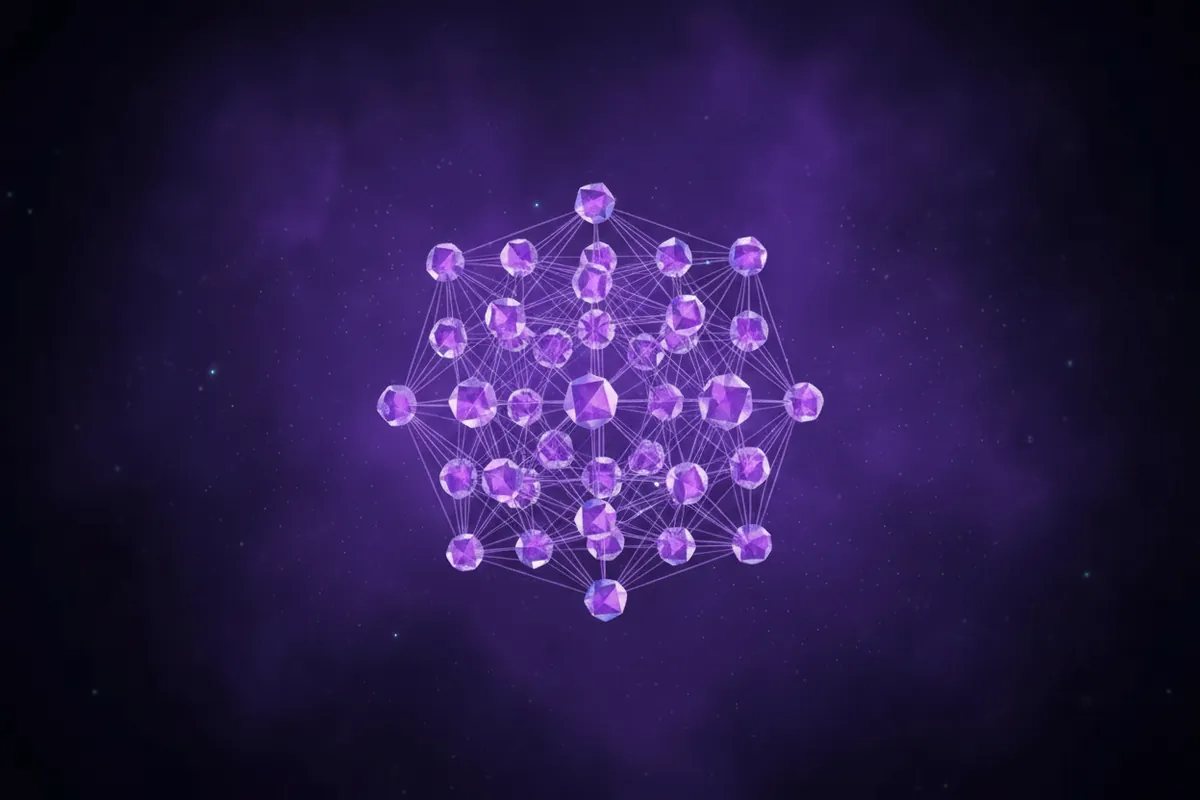
The five sisters are the inference layer, but the swarm that produces a forecast is larger: 23 agents that exchange traces via Google A2A protocol (JSON-RPC over HTTP) and merge their outputs via CRDT — conflict-free replicated data types. There is no central orchestrator deciding who speaks when. Each agent produces its trace; the traces merge into a single agent-trace record that the manifest carries. The merge is deterministic; the convergence is by construction, not by coordination.
Why A2A, not a custom protocol
Google A2A (Agent-to-Agent) is an open spec for agent communication over JSON-RPC. We use it because it lets a sister move out-of-process — or off-box — without changing the callers. The sister is an A2A agent; the caller is an A2A client. The protocol is the contract. A sister that runs in a separate process today and in a separate datacenter tomorrow is the same code, because the transport is A2A and the interface does not change. That is provider-agnostic at the agent layer, the same way OpenAI-compatible is provider-agnostic at the model layer.
Why CRDT, not voting
The easy merge is voting — take the median, discard the outliers. Voting discards disagreement, and disagreement is the signal. A CRDT merge preserves all traces and merges them into a structure that is deterministic regardless of arrival order — which is the property a distributed system needs when it cannot guarantee ordering. The agent-trace record in the manifest is the CRDT-merged set of all participating agents traces. An auditor sees the full set, not a winner-takes-all summary; the disagreement is data, not a discarded byproduct.
Voting discards disagreement. CRDT preserves it. The disagreement is the signal — and the manifest carries it, not a winner-takes-all summary.
- A2A (JSON-RPC/HTTP): open protocol, lets a sister move out-of-process without changing callers.
- CRDT merge: deterministic regardless of arrival order — convergence by construction.
- 23 agents, no orchestrator: the merge is the agreement; the center is absent by design.
Why no orchestrator
An orchestrator is a thing that decides who speaks next. In a swarm of 23, that is a bottleneck and a single point of failure. The CRDT removes the need: each agent produces its trace independently, the merge is commutative and associative, and the final merged trace is the same regardless of the order in which traces arrived. The system converges because the merge function is a CRDT, not because a coordinator sequenced the work. That is the property that makes the swarm horizontally scalable — add agents, the merge still converges — and the property that makes the agent-trace record reproducible: the merge is deterministic, so the same traces always produce the same merged record.
What the manifest carries
The agent-trace field in the manifest is the CRDT-merged record of all 23 agents. Because the merge is deterministic, the same set of traces always produces the same record — which is what reproducibility requires. An auditor with the 23 traces and the merge function can reproduce the merged record bit-for-bit. The disagreement is preserved in the record, not collapsed into a vote; the ensemble reads it as entropy. We are building the POC; the swarm runs, the merge is built, and the convergence is by construction.
The orchestrator is the bottleneck a distributed system builds when it does not trust its parts to converge. CRDT is how you trust them. The merge is the agreement.
— swarm design note