Point predictions are a liability
Why a single number is the one thing a CRO cannot defend — and why a distribution is the thing they can.

A point estimate is a bet you cannot hedge. A distribution is a bet that tells you how much to hedge. One of those survives a board meeting.
A point prediction — "the default rate will be 4.2%" — is the most defensible-looking and least defensible thing a model can produce. It looks precise, which reads as confident, which reads as authoritative. It is none of those. It is a single draw from a distribution the model collapsed into a number, and the moment it is wrong, there is nothing to point at — no spread, no entropy, no second scenario. A CRO handed a point estimate has been handed a bet with no hedge.
A distribution carries its own doubt
A probability distribution over scenarios carries its own doubt in its shape. High entropy means "I genuinely do not know which of these will happen." Bimodal means "it is one of two regimes, and I cannot tell which." A sharp peak means "I am confident, and here is how confident." That shape is what a CRO reads to decide how much to hedge. A point estimate has no shape; it has a number and a silence where the doubt should be.
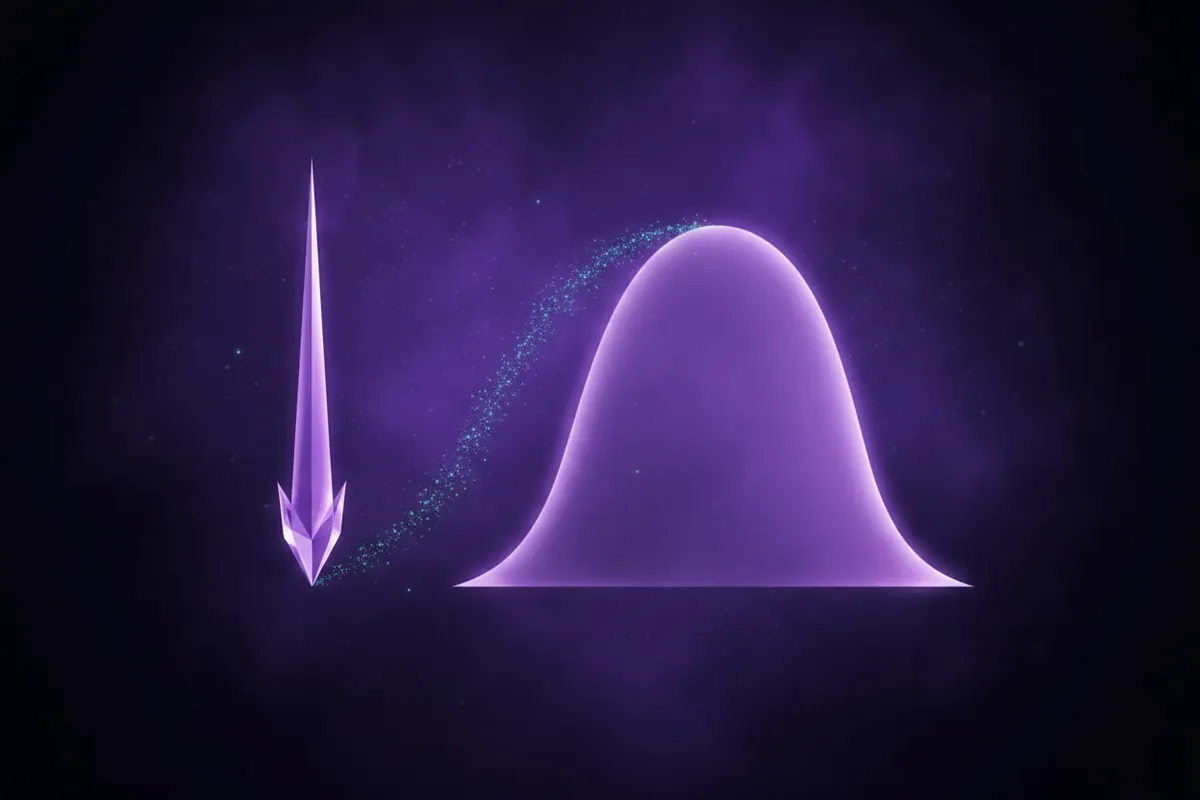
Why a point fails a board meeting
The board question that kills a point estimate is "what if you are wrong?" A point has no answer; "4.2%" is either right or it is not. A distribution has an answer: "if the tail regime fires, here is the scenario and its probability; we are hedged for it at this weight." The distribution turns "what if you are wrong" from an accusation into a contingency. That is why distributions, not numbers, are what a CRO can defend — and why the Oracle normalizes into an Ensemble, not a number.
The board question that kills a point estimate is "what if you are wrong?" A point has no answer. A distribution turns the question from an accusation into a contingency.
- Probabilities normalize in one place (deino-oracle): sum ≈ 1.0, scenarios sorted, entropy in nats — a guarantee consumers rely on.
- Entropy is the honesty field: it tells the CRO how spread the model’s doubt is.
- A distribution is hedges-able; a point is not. Defensibility lives in the shape.
Calibration, not confidence
A distribution is still only as good as its calibration. The Oracle’s distributions are scored against the realized timeline — Brier, log-loss, via deino-eval — and Gate 1b requires a shadow run to beat a disclosed baseline before any forecast side is positioned as accurate. A well-shaped, uncalibrated distribution is a more sophisticated lie than a point estimate, not a better one. Calibration is the loop that earns the word "probability." We are pre-revenue, building the POC; the distributions are produced, and the calibration loop is inert until it is filled.
A point estimate is a bet with no hedge. A distribution is a bet that tells you how much to hedge. Only one of those survives a board meeting — and only one of those is honest about its own doubt.
— risk note